
This guide was curated from 6 Korean-language blog posts, 6 YouTube videos, and 9 Unsplash photographs, then reimagined for international travelers. Full attributions are listed at the bottom of this article.
Take the Honam Line south — south, and then further south — and eventually you arrive at a station where the rails simply stop. This is Mokpo (목포). Perched at the southwestern tip of the Korean peninsula, just 2 hours and 40 minutes from Seoul by KTX, this port city has long been overshadowed by flashier destinations. Yet everyone who visits comes back saying the same thing: “Nine out of ten restaurants here are amazing,” and “Two meals a day is never enough.” Mokpo calls itself the “City of Flavor,” and it is one of the rare places that actually lives up to the name.
Nakji-tangtangi (낙지탕탕이, chopped live octopus seasoned with sesame oil), jungkkan (중깐, Mokpo’s own thick spin on black bean noodles), a bone-broth hangover soup that has simmered in the same shop for 53 years, and a bakery that has been pulling bread from its ovens since 1949 — between the narrow alleys of the old town and the coastal boulevards of the new district, Mokpo keeps its own quiet rhythm of time.
Video: “나혼자 목포여행 하루 2만보씩 걸은 알찬 코스” by 홍로미 hongromi
1. Reading the Layers of a Port City — Culture and History
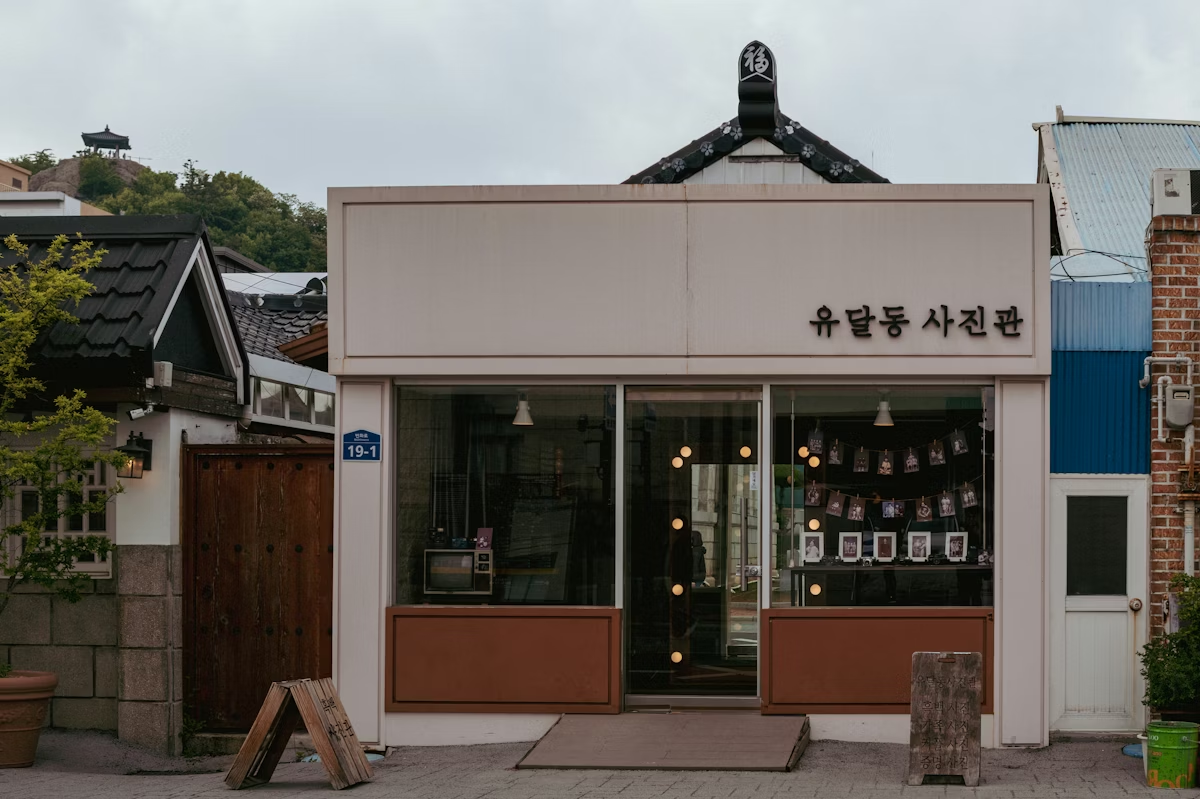
Mokpo opened as a treaty port in 1897, and the city’s appeal springs from the way natural beauty and modern history have accumulated in visible layers. The main sights cluster around the old town and Yudalsan (유달산), so a single day is enough to cover the highlights.
1-1. Yudalsan — A 228-meter Observation Deck
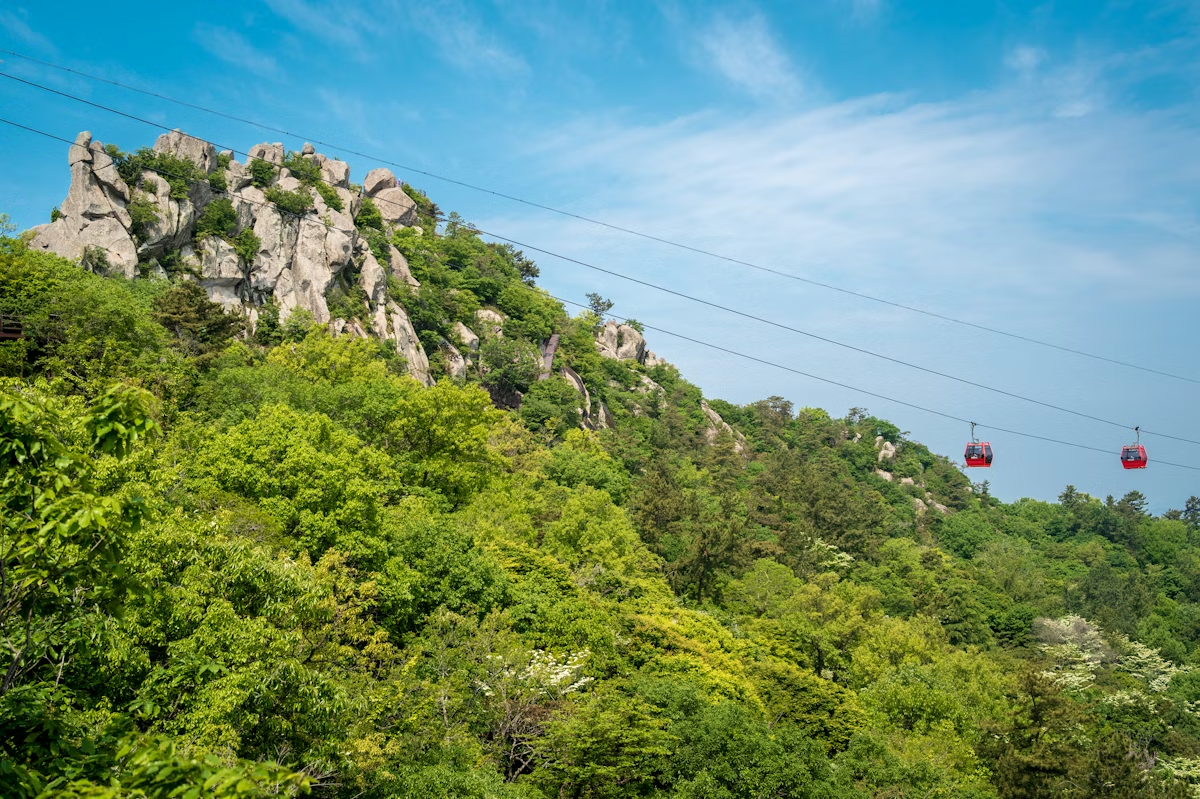
Yudalsan (유달산) is Mokpo’s signature landmark. At just 228 meters above sea level, it feels more like a brisk walk than a hike — you can reach the summit in 30 to 40 minutes. From the top, Mokpo Harbor, the Dadohae (다도해, the archipelago of islands off Korea’s southwest coast), and Mokpo Bridge spread out beneath you. Climb in the late afternoon and you will catch the sun sinking over the islands — a moment many Korean bloggers single out as the highlight of a Mokpo trip.
Video: “등산하고 또 등산하는 목포여행 인생 첫 곱국수” by 노유디YOODI
1-2. Mokpo Marine Cable Car — Korea’s Longest at 3.23 km
The Mokpo Marine Cable Car (목포해상케이블카) crosses the sea from Yudalsan to Goha-do (고하도) Island along a 3.23-kilometer route — the longest ocean-spanning cable car in the country. Opt for the crystal cabin (a gondola with a transparent floor) and you will find the ocean opening up directly beneath your feet. Adult round-trip tickets cost 24,000 KRW (~$17 USD); operating hours are 09:30–19:00.
1-3. 1897 Open Port Street and the Modern History Museum
A short walk from Mokpo Station, 1897 Gaehang-geori (1897개항거리, the historic street marking Mokpo’s 1897 treaty-port opening) preserves colonial-era architecture from the Japanese occupation. The Modern History Museum (근대역사관) occupies early-1900s buildings repurposed as exhibition spaces, offering a window into what Mokpo looked like when it first opened to the world. Budget 30 to 40 minutes for a thorough visit.
1-4. Sihwa Alley — Filming Location for the Movie 1987
In the Seosan-dong (서산동) neighborhood, Sihwa Golmok (시화골목, a mural-art alley) winds past painted walls and small art installations. It is also home to Yeonhui-ne Super (연희네슈퍼), a location featured in the Korean film 1987 — a must-stop for movie fans. Tiny galleries and cafes hide in the side streets.
Video: “목포는 이렇게 가야지 진짜 목포 여행 제대로 즐기는곳입니다” by 맛관부
1-5. Pyeonghwa Plaza and the Dancing Sea Fountain
In the new town, Pyeonghwa Gwangjang (평화광장, Peace Plaza) faces Mokpo Bridge and the Dadohae archipelago — a prime spot for sunsets. After dark, the Dancing Sea Fountain (춤추는 바다분수), one of the largest ocean fountains in the country, performs a choreographed light-and-music show. Admission is free.
💡 Local Tip (via “여행보물창고”‘s blog): For the most efficient route, plan DAY 1 as: Modern History Museum → Sihwa Alley → Marine Cable Car → Yudalsan sunset → Pyeonghwa Plaza fountain show.
2. A City That Proves Every Meal Matters — Signature Foods
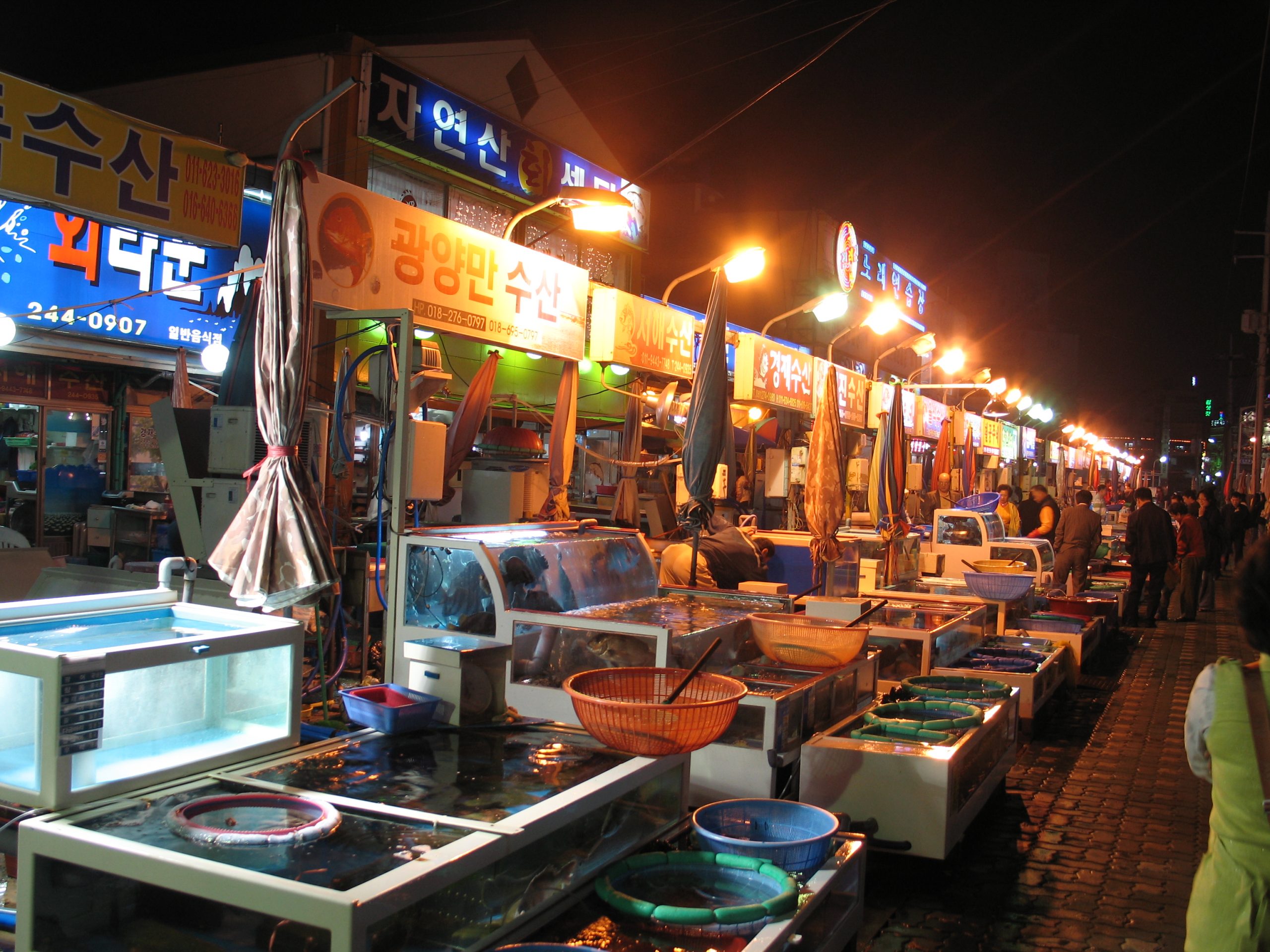
It is no exaggeration to say that half of a Mokpo trip is a restaurant crawl. One Brunch writer (“위트립”) spent an entire month in Mokpo, visited more than 30 restaurants, and concluded that the city has a “90-percent hit rate for great food.” Octopus, blue crab, gizzard shad, croaker, skate, butterfish — as befits a port city rich in seafood, Mokpo offers dishes you simply cannot find in Seoul.
2-1. Raw Seafood — Mokpo’s True Colors
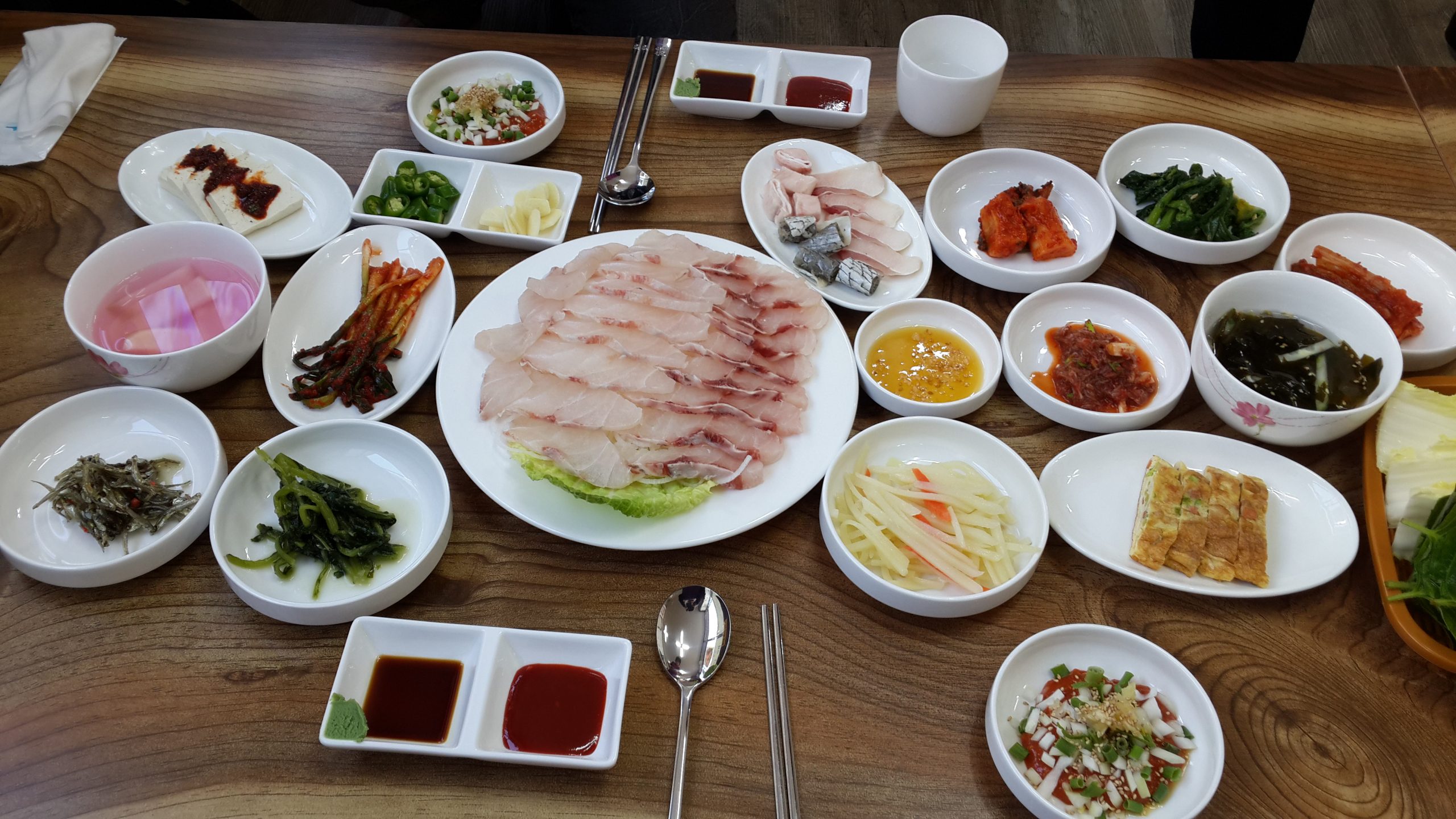
Nakji-tangtangi (낙지탕탕이, fresh live octopus pounded on a cutting board — tang-tang — chopped fine, and dressed in sesame oil and crushed sesame seeds) is the dish that defines Mokpo. The texture of utterly fresh octopus is unforgettable. Try it at Hadang Meokgeori (하당먹거리) for 59,000 KRW (~$42 USD) for two.
Junchi-hoe-muchim (준치회무침, gizzard shad sashimi salad) is at its seasonal best in spring. Seongyeong Junchi Hoetjip (선경준치횟집) serves it for 10,000 KRW (~$7 USD), and you can also order byeongeo-muchim-hoe (병어무침회, butterfish sashimi salad) at the same restaurant.
Mineo-muchim-hoe (민어무침회, croaker sashimi salad) is the specialty at Mokpo Anakne (목포아낙네), located in the area known as Croaker Street (민어의 거리). Croaker is a prized fish in Mokpo — the sashimi salad offers a clean, chewy bite.
Kkotge-muchim (꽃게무침, seasoned blue crab) can be enjoyed at Jangter Sikdang (장터식당, also known as Jangter Bonjeom) for 30,000 KRW (~$21 USD) for two.
2-2. Jungkkan and Bone Hangover Soup — One-Bowl Mokpo
Jungkkan (중깐, Mokpo’s variation on gan-jjajang — black bean noodles with a thicker, richer sauce) is a local staple. Junghwaru (중화루) is credited as the originator (8,000 KRW / ~$5.70 USD), though some diners note the noodles tend to stick together. Brunch writer “위트립” prefers Daemyeongchun (대명춘), where thin noodles are wrapped and eaten by hand. Taedong Sikdang (태동식당) is another favorite — known for the generous bonus servings of jjamppong (spicy seafood noodle soup) and tangsuyuk (sweet-and-sour pork) that come on the side.
Ppyeo-haejang-guk (뼈해장국, bone hangover soup — a clear broth topped with sliced green onion) is the quintessential morning-after cure. Haenam Haejangguk (해남해장국), in business since 1972 with 53 years of tradition, is the benchmark at 12,000 KRW (~$8.60 USD). Eunjine Haejangguk (은지네해장국) serves the same clean-broth style and is equally popular.
Video: “목포여행 브이로그 | 1박2일 같은 2박3일 목포 먹여행 브이로그” by 떼떼롱 ttettelong
2-3. Yukhoe Bibimbap and Baekban — The Namdo Table
Yukhoe-bibimbap (육회비빔밥, Mokpo-style bibimbap topped with unseasoned, chunky raw beef over stone-pot rice) can be found at Ujeong Jeongyuk Sikdang (우정정육식당) and Yeonhui-ne Pocha (연희네포차, where the yukkoebi platter costs 39,000 KRW / ~$28 USD).
Namdo baekban (남도 백반, a southern-style set meal with more than ten side dishes) is served at Yeongsimi Baekban (영심이백반), a local favorite near the Bukhang raw-fish district.
Hongeo-samhap (홍어삼합, a trio of fermented skate, boiled pork belly, and aged kimchi wrapped together) is the signature dish of Korea’s Namdo region. The intensely pungent fermented skate divides opinion, but if you have traveled all the way to Mokpo, it is worth the adventure.
💡 Local Tip (via “위트립”‘s blog): Most Mokpo restaurants see long lines during the lunch rush (11:30 AM–1:00 PM). Arrive at seafood restaurants before 11:00 AM and you can usually walk right in.
Video: “나혼자 목포 현지인의 추천 맛집 코스” by 꼬까리 KKOKKIRI
3. Bakeries and Cafes — Mokpo’s Sweet Pause
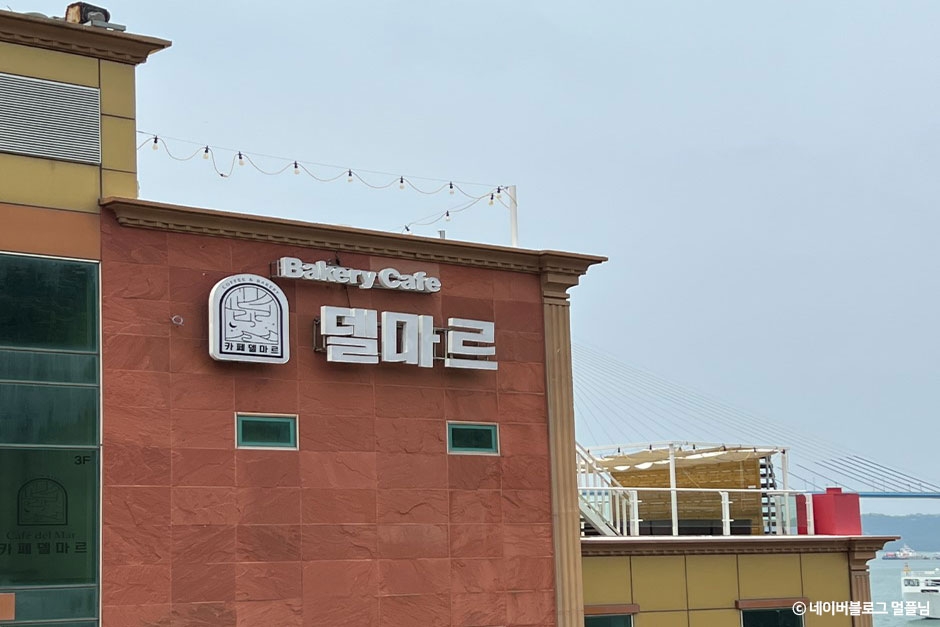
After filling up on seafood and noodles, it is time for a sweet intermission. Mokpo does not have the trendy cafe streets you might find in Jeonju’s Hanok Village, but what it offers instead are spaces steeped in decades of character.
3-1. Colombang Bakery — Baking Since 1949
Colombang Jekwa (코롬방제과, Colombang Bakery) opened its doors in 1949 and has held the same spot for over 70 years, serving generations of Mokpo residents. The cream baguette and shrimp baguette are the house signatures, while the yeonyu-bol (연유볼, condensed-milk roll) is another can’t-miss favorite. No Mokpo itinerary is complete without a stop here.
3-2. Yeongguk Dabang
Yeongguk Dabang (영국다방, a retro-style tearoom in the old town) brims with vintage atmosphere. Its hazelnut latte is the signature drink, and its location — right between 1897 Open Port Street and Sihwa Alley — makes it an ideal rest stop between sightseeing rounds.
3-3. Daebandong Coastal Road
Along the Daebandong (대반동) coastal road, a skywalk lets you feel as though you are strolling over the ocean, while a string of cafes with views of Yudalsan lines the waterfront.
4. Practical Information You Will Want to Know
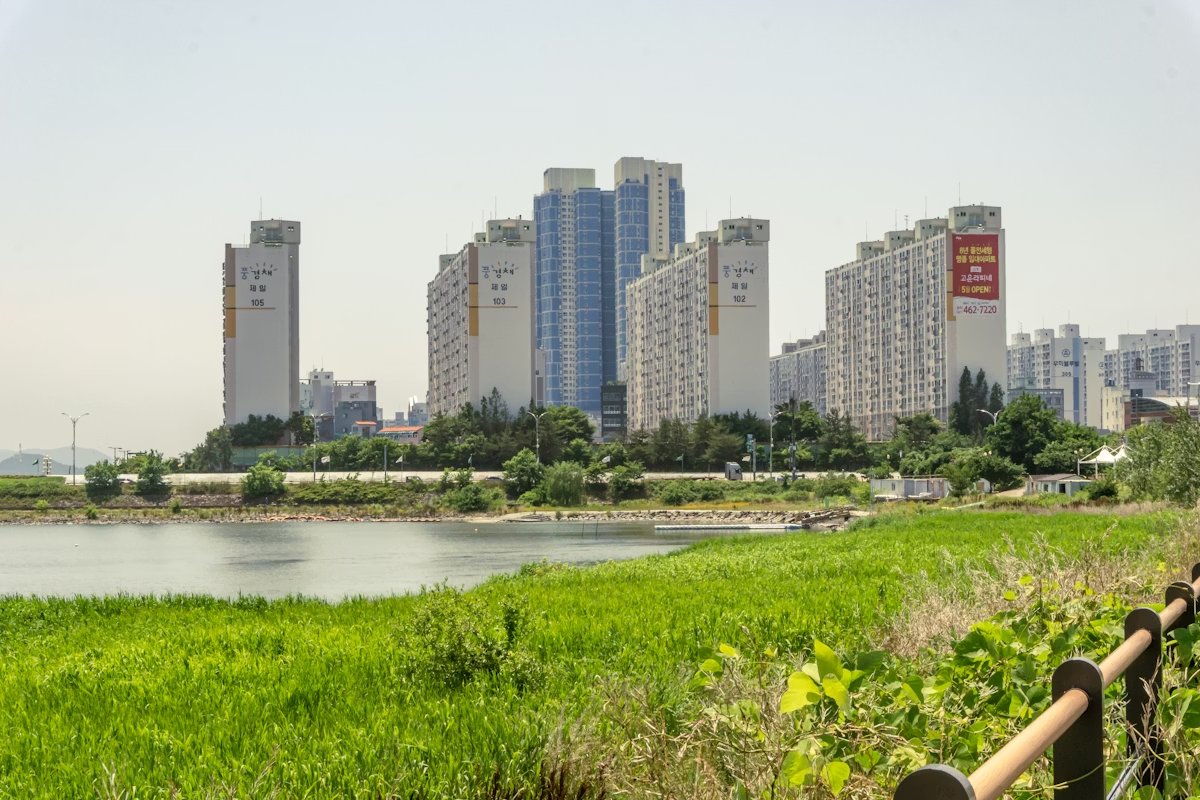
Getting There
- Seoul to Mokpo: About 2 hours 40 minutes by KTX from Seoul Station. The SRT from Suseo Station is another option. The Honam Line terminates at Mokpo Station, branching from the main line at Iksan.
- Getting around: Mokpo is a compact city — most taxi rides cost under 10,000 KRW (~$7 USD). Even a cab from the old town to the new district (Pyeonghwa Plaza) is affordable, and local buses run frequently.
Where to Stay
- Old town (near Mokpo Station): Older accommodations, but excellent access to restaurants and historic sites.
- New town (near Pyeonghwa Plaza): Clean, modern hotels with night views and easy access to the coastal promenade.
Best Season
- Mokpo sits on the southwest coast, so winters are milder than in Seoul. Spring (March–May) and autumn (September–November) are the most pleasant, but winter trips are perfectly viable.
- Seasonal specialties like junchi-hoe (gizzard shad sashimi) are at their best in spring.
Suggested Itinerary
- 1 night, 2 days: DAY 1 — Modern History Museum → Sihwa Alley → Marine Cable Car → Yudalsan sunset → Pyeonghwa Plaza fountain show. DAY 2 — Natural History Museum → Samhak-do Park → restaurant crawl. Estimated total for two people: roughly 450,000–500,000 KRW (~$320–$360 USD).
- 2 nights, 3 days or more: The restaurant scene alone can fill the extra time — some bloggers have reported spending as many as 4 nights and 5 days.
Map Apps and Payment
In Korea, skip Google Maps and use Naver Map or KakaoMap instead. They are far more accurate for Mokpo’s small restaurants and narrow alleys. Most restaurants accept cards, but cash is more convenient at markets and street stalls.
💡 Local Tip (via “zzoos”‘s blog): Mokpo is small enough that even a taxi from the old town to the new district rarely exceeds 10,000 KRW (~$7 USD). Move freely between both areas and experience the best of each.
Video: “1박2일 목포여행 5분 요약” by 윤채미 yoonchaemi
5. Not an End, but a Beginning — Leaving Mokpo
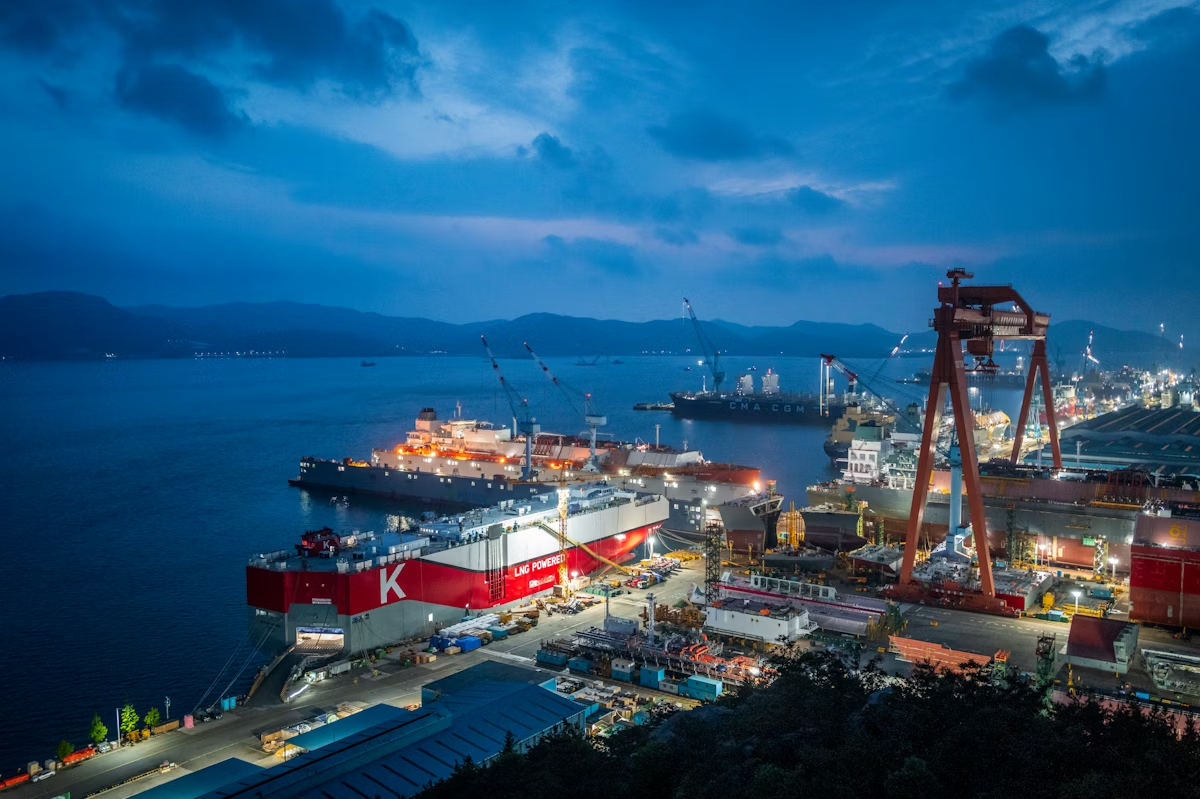
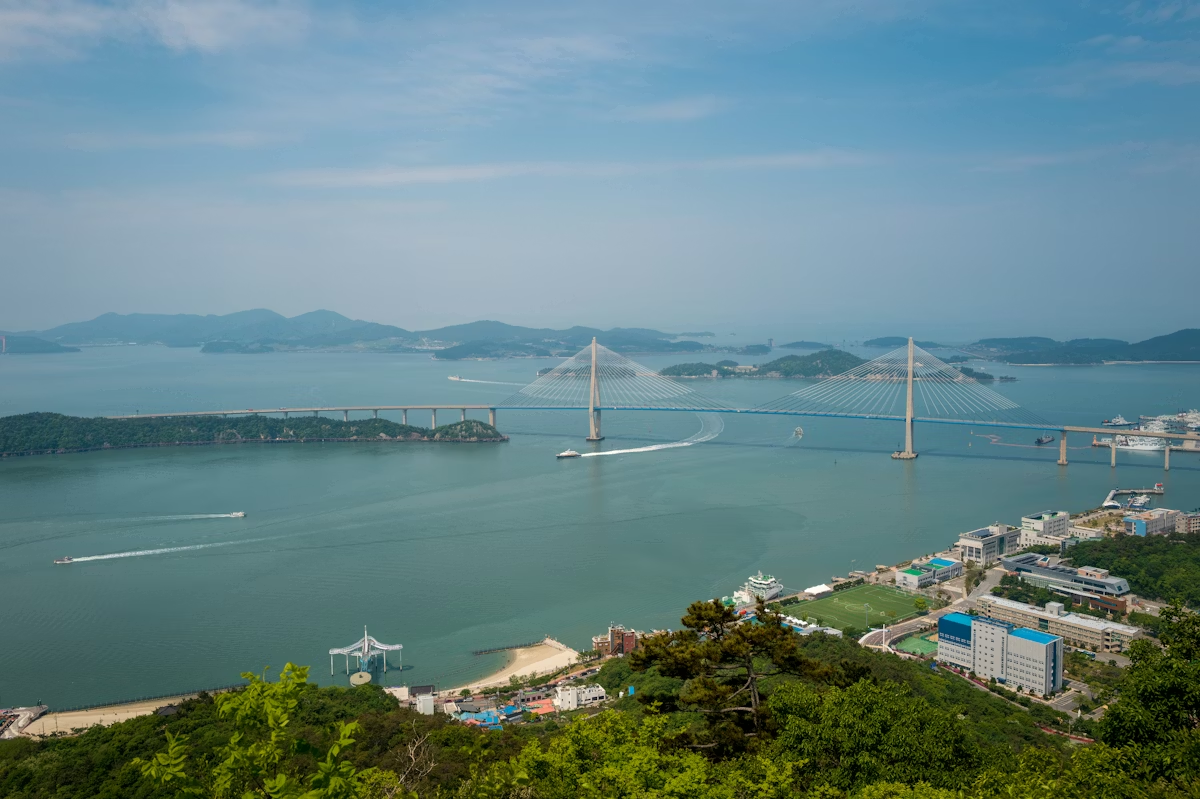
The journey that begins at the last stop on the Honam Line turns out to be not an ending but a fresh discovery. The scatter of islands viewed from the top of Yudalsan. A plate of nakji-tangtangi, made to the rhythmic tang-tang of a knife on the cutting board. A hangover-soup shop that has been ladling the same clear broth for 53 years. A single condensed-milk roll from a bakery that has been baking since 1949. Mokpo is not a city that shouts for attention. Instead, each meal, each alley, each view accumulates quietly and stays with you long after you leave.
If, on the way back to Mokpo Station, you catch yourself thinking “Next time I need to try the hongeo-samhap,” or “I should come in summer for the butterfish sashimi” — that is Mokpo’s invitation, already accepted.
May you find the deepest flavors of Korea’s south in Mokpo.
Sources & References
This guide was curated from the following Korean-language sources:
Blogs & Articles
– “목포 맛집 베스트10 추천” by jdblue2022 — https://jdblue2022.tistory.com/entry/%EB%AA%A9%ED%8F%AC-%EB%A7%9B%EC%A7%91-%EB%B2%A0%EC%8A%A4%ED%8A%B810-%EC%B6%94%EC%B2%9C
– “목포에선 맛 여행이지” by 위트립 — https://brunch.co.kr/@fa8c37a4da78485/253
– “목포 가볼만한곳 베스트10 추천(+2025년 최신)” by 여행보물창고 — https://k99999.tistory.com/entry/%EB%AA%A9%ED%8F%AC-%EA%B0%80%EB%B3%BC%EB%A7%8C%ED%95%9C%EA%B3%B3-%EB%B2%A0%EC%8A%A4%ED%8A%B810-%EC%B6%94%EC%B2%9C2025%EB%85%84-%EC%B5%9C%EC%8B%A0
– “목포 여행 코스” by ironstagram — https://brunch.co.kr/@ironstagram/60
– “이번 여행은 목포입니다” by zzoos — https://brunch.co.kr/@zzoos/301
– “2025 목포 여행 완벽 가이드” by 여행하는고모 — https://yojinyo1004.tistory.com/entry/%F0%9F%8C%8A-2025-%EB%AA%A9%ED%8F%AC-%EC%97%AC%ED%96%89-%EC%99%84%EB%B2%BD-%EA%B0%80%EC%9D%B4%EB%93%9C-1%EB%B0%95-2%EC%9D%BC-%EC%9D%BC%EC%A0%95%C2%B7%EB%B9%84%EC%9A%A9%C2%B7%EB%A7%9B%EC%A7%91%C2%B7%EC%97%AC%ED%96%89%ED%8C%81-%EC%B4%9D%EC%A0%95%EB%A6%AC
Videos
– “나혼자 목포여행 하루 2만보씩 걸은 알찬 코스” by 홍로미 hongromi — https://www.youtube.com/watch?v=EviB5Qt3G6A
– “등산하고 또 등산하는 목포여행 인생 첫 곱국수” by 노유디YOODI — https://www.youtube.com/watch?v=yD6X0XcFEd8
– “목포는 이렇게 가야지 진짜 목포 여행 제대로 즐기는곳입니다” by 맛관부 — https://www.youtube.com/watch?v=nZAROKzK0lE
– “목포여행 브이로그 | 1박2일 같은 2박3일 목포 먹여행 브이로그” by 떼떼롱 ttettelong — https://www.youtube.com/watch?v=pjAULrDgacE
– “나혼자 목포 현지인의 추천 맛집 코스” by 꼬까리 KKOKKIRI — https://www.youtube.com/watch?v=OXuy5dtmU6s
– “1박2일 목포여행 5분 요약” by 윤채미 yoonchaemi — https://www.youtube.com/watch?v=Ir-xj6ybDzY
Images
– Photo on Unsplash — https://images.unsplash.com/photo-1748267488259-e32349e485d1
– Photo on Unsplash — https://images.unsplash.com/photo-1748077228194-e7d5b947287a
– Photo on Unsplash — https://images.unsplash.com/photo-1623582532259-396e1b43c73e
– Photo on Unsplash — https://images.unsplash.com/photo-1702737940586-e0045bc9491e
– Photo on Unsplash — https://images.unsplash.com/photo-1703925155035-fd10b9c19b24
– Cafe del Mar, Mokpo — Korea Tourism Organization (KOGL Type 3)
– Photo on Unsplash — https://images.unsplash.com/photo-1623592303195-655ff4b2bed8
– Photo on Unsplash — https://images.unsplash.com/photo-1747568800975-4db9fdc53762
– Photo on Unsplash — https://images.unsplash.com/photo-1747573453627-0c6bf3477b8e
All content has been summarized and adapted for international readers. Original authors retain full copyright of their work.